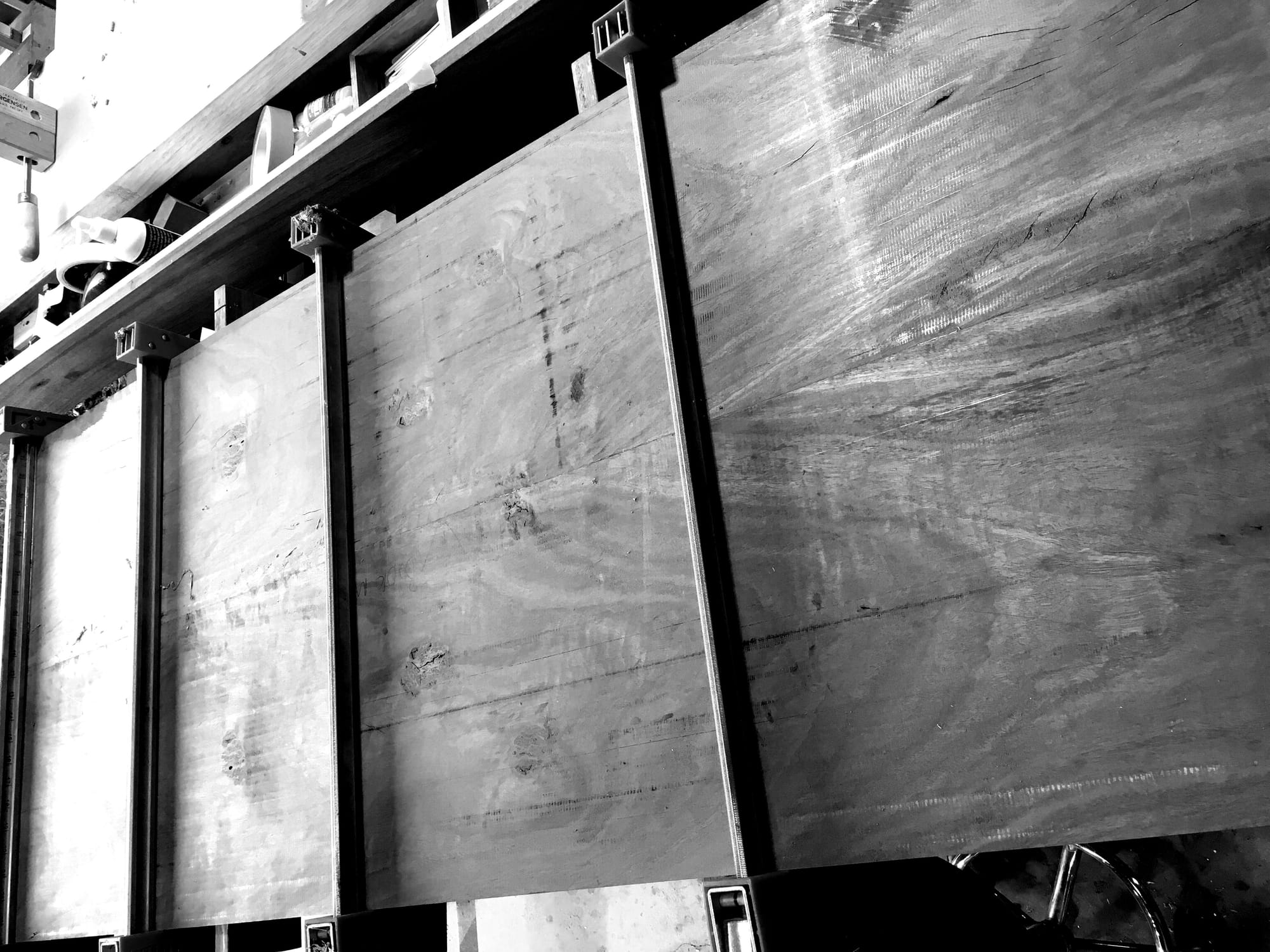
Three days this week I was unstoppable. Schwarz gave a commandment - haul ass - and who am I to refuse. The desk flew. Floating panel done, dovetailed cross members done, the tricky compound joinery at the corners done, frame members done. Rebated. Sanded. Assembled. Done done. I even invented[1] a router jig to trim the cheeks of the mitred tenons, in this case to ensure square cheeks and a clean transition where the red gum refuses to be worked by hand. Version one was a bodge job held together with offcuts and optimism, but it worked so well I'll build a proper one as soon as I have the time.
Then today happened. A cacophony of cock-ups; a gaggle of gaffs. Dropped things. Fumbled workarounds. One of those days where the workshop actively resists you, where every tool is in the wrong place and every cut needs a bit too much tweaking. Sometimes 'hauling ass' is right. Sometimes the better move is to retreat: clean the bench, shut the door, and hope that tomorrow will be different.
In other news, a name I'd never heard before appeared roughly 150,000 times this week. John Ruskin. He kept turning up in things I was reading, things I was listening to, conversations I wasn't expecting. When something up in the universe throws something that insistently at you, eventually you should pay attention. So I read him.
How had I not heard of this man?! Ruskin watched the Industrial Revolution hollow out skilled handwork and replace it with machine production, and he argued - fiercely - that the quality of a made object is inseparable from the moral and spiritual condition of the person who made it. That a society which treats its workers as interchangeable parts will produce ugly things, and that ugly things will in turn degrade the society that tolerates them. I read that and felt the floor tilt. There is a straight line from Ruskin through William Morris through Wendell Berry through Paul Kingsnorth and directly into this workshop. He might be the father of every thought I've had about craft and work and what it means to make something with your hands.
Chris Hall wrote about this too - the utter annihilation of beauty in our built environment since mechanisation took hold. Drive through any new housing estate and you can see what Ruskin predicted. Nobody sat down and decided to make everything awful, it just happened. The natural, apparently predictable, evolution of mechanisation replacing judgement with margin. And the people who had the power to turn the ship around lined their pockets instead. Whether that's dullness, wilful ignorance of the environmental destruction, or just a luxury belief — it's easy for politicians to be blind to how ugly most housing is in Australia when they go to work in a magnificent old building and pull their luxury car into the driveway of a magnificent old house. Ruskin would have wept. Hall just got angry, which is a more human response.
Ruskin's argument about machines and handwork maps almost perfectly onto what's happening with AI right now. A type of machine can produce the impression of craft just as another can produce the impression of thought. But it can't produce what D.H. Lawrence called the transferred touch, the pulse of a life that stays in the things a person has made. AI can be a useful tool, but the simulation of humanity is not humanity. The impression of handwork is not handwork. But neither are valued the way the human-made original is: no AI-written novel will impact the world like Dostoevsky; no AI art will be discussed for centuries like Michelangelo. Ruskin knew this about the steam engine and it seems nothing has changed. The unthinking launch into AI use has the potential to become as ugly as the unthinking abandonment of human craft.
Anyways, the class I was going to teach has been cancelled, which means I now own a set of paring jigs with no home to go to. If anyone wants one, let me know!
- I am certain I've once again invented something that already exists. I do that a lot. ↩︎
Join the conversation