Once again the poo fairy (or maybe her cousin this time) has graced our family, so once again I find myself thinking more than doing, which is all but guaranteed to have a man lose his head further and further up his own bum.
What better time then to tackle the subject of my talk, "The Meaning of Craft in the Age of AI": a title I did not choose, and would not have. Being formally educated in philosophy I know the first step is always to change the exam question to something that's easier to answer: What even is "Craft"?
I should say up front that in the workshop nobody asks "what is the meaning of all this?!". The question has never once occurred to me while I was holding a chisel. It only pops up when I'm not, which is now, which is why you're getting a bloviating essay.
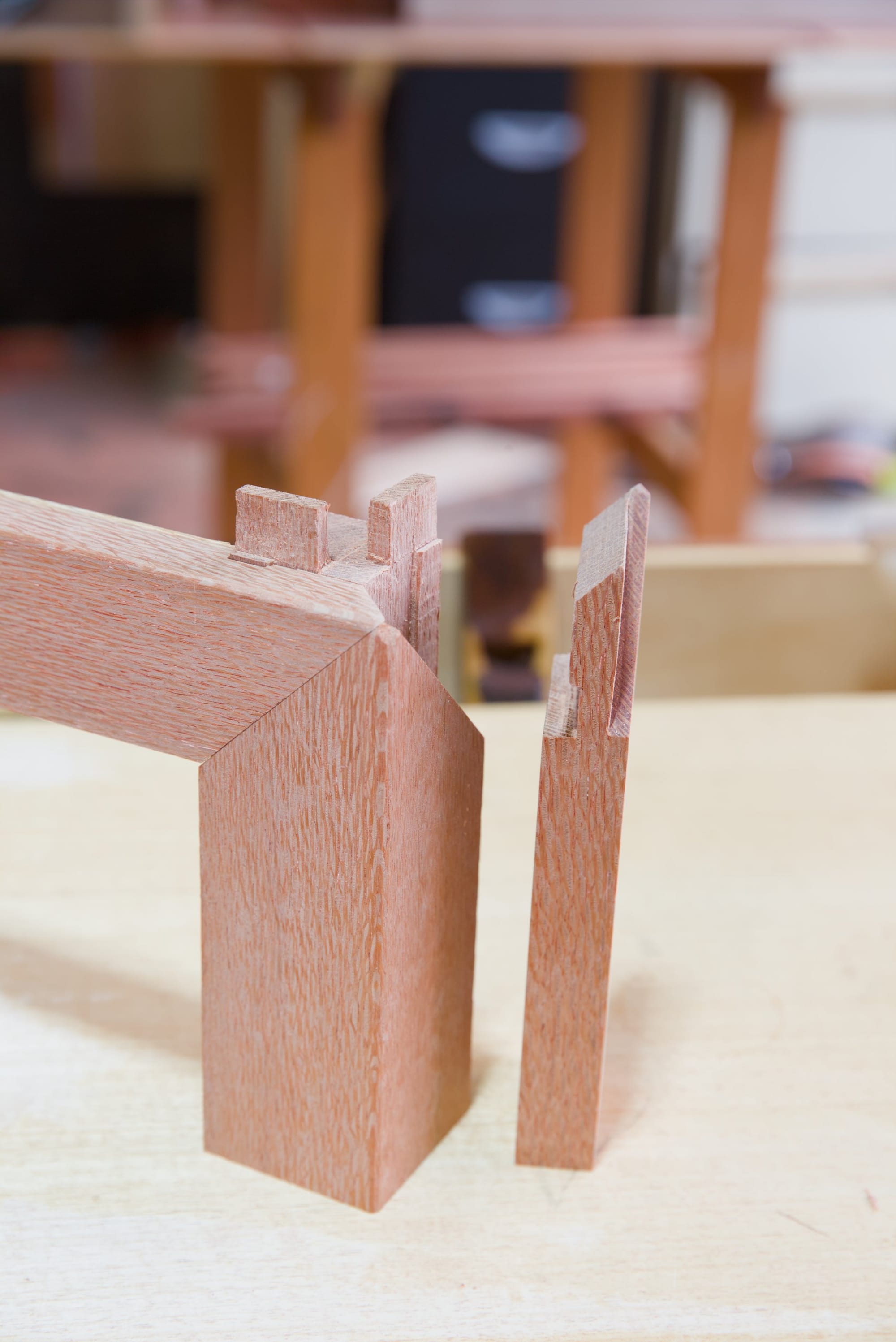
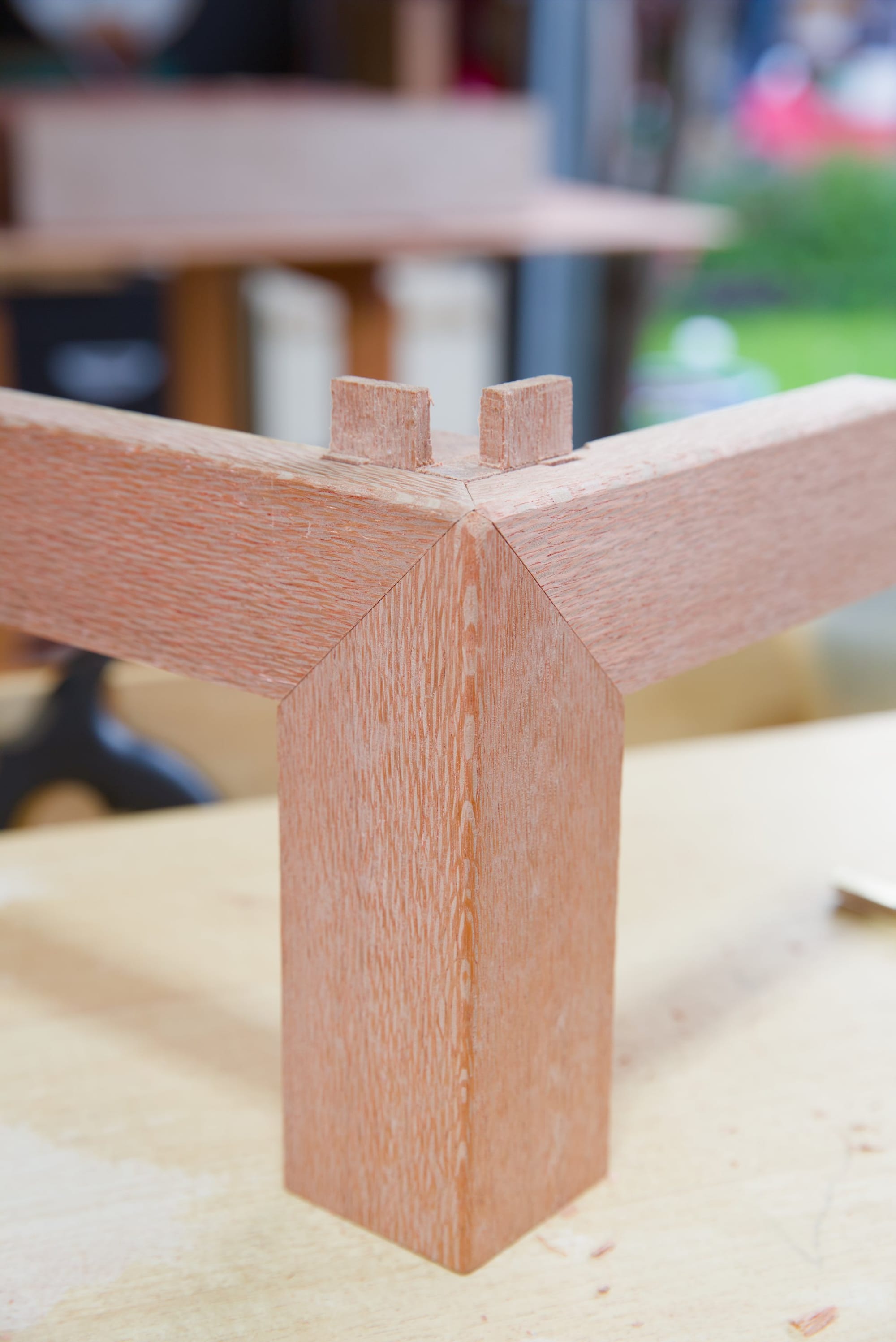
Somebody held a joinery sample of mine recently — a three-way mitre from a Ming-style table corner, six hundred years of geometry packed into a lump of Silky — and, with a wink, asserted I'd made it with a CNC, of course.
I want to be fair to this person. They didn't mean it unkindly, probably. In our world calling a man "a machine" is the highest compliment you can pay a specimen of alpha-male magnificence. Some may well imagine that calling a painting "photographic" is the highest compliment you can pay a painter. In either case the compliment works by suggesting that the human has successfully impersonated a machine, which is, for some reason, considered a good thing. Funny then that people are losing their marbles now that the machines are impersonating us.
Funnier still, a CNC can't make that joint. Not won't. Not hasn't got around to it yet. Can't. The joint is pocketed — housed into the leg on a dovetailed slide — and the cutter would need to reach the mortise floor to shape the pocket, except the dovetail is in the way. You can reach the floor or you can keep the dovetail. You cannot do both with a CNC. It is the joinery equivalent of being told you can have the window seat or the legroom: the aircraft was not designed by someone who thought you deserved both.
So the person who held my joint and mistook it for machine work had, with great confidence, identified the one object in the room that proved the opposite of what they were saying. They had complimented my hand by calling it a machine that cannot make the thing my hand had made. And I stood there and smiled, because what else do you do? You can't explain a sliding dovetailed mortise pocket at a dinner party. I could barely explain it in a woodworking class.
I think about that moment more than I should. Partly because it's funny. Partly because the gorilla in me still thinks being called a machiiiine is a compliment. But mostly because it's a Catch-22 that Heller would have admired: the better I get at hand-cutting this joint, the more it looks like a machine did it, which is the proof that a machine didn't, because a machine can't, which is why I'm cutting it by hand, which is why it looks like a machine cut it — and round we go, faster and faster, until the only way to prove I made it by hand is to intentionally make it badly.
There's a line people draw when they talk about work like this, whether it's furniture, ceramics or macrame. Art on one side, craft on the other. Imagination over here, skill over there. Always one or the other, always a binary. A Welsh chair maker called John Brown put it as sharply as anyone: most work, he said, is either all imagination and no skill, or all skill and no imagination.
It's a sharp knife. I'm stealing it. Partly because I've accepted my place in this world as an unoriginal hack, but also because I want to stick it in and twist it a bit. The divide doesn't just sort the sincere from the fraudulent, it has become the primary sorting mechanism of the fraudulent.
Take the imagination end. I was shown a shelf once. A small wooden bracket, with a cute little pivoting drawer, that goes on the wall by your front door: the spot where you dump your keys and the junk mail and the receipt for the parking fine you'll claim you never got. I was told this shelf was an exploration of space.
Now, strictly speaking, all shelves explore space. That is what a shelf does. It occupies a region of space and invites you to put things on it. Without exploring space, a shelf would be a thought, and you can't put your keys on a thought — although I suspect someone in that room was working on a grant application to try. So in one sense the description was perfectly accurate. In every other sense it was, to blow my call back early, explosive and sloppy excrement. The shelf had no particular skill in it and no particular idea behind it, beyond the idea that if you call a shelf an exploration of space a certain type of person will nod slowly and ask about your creative process. I believe the fellow also used the word "subversion." The shelf was subverting space. What it was actually subverting was my desire to remain in the conversation.
I couldn't explain why I find this kind of thing so grating until I chanced upon Meskin and Weinberg, writing in Psyche. Pretentiousness, they argue, isn't just a vibe, it's a specific structural failure: a mismatch between an artwork's ambitions and its actual achievements. It's the signature of work that wants to be taken seriously without doing the serious work. It constructs the appearance of significance because the real thing — genuine depth that a genuine audience can actually read — is extremely difficult. The shelf isn't a failed attempt at it; the shelf isn't attempting it at all. It's operating in a closed loop: shelf-makers showing shelves to shelf-admirers who write about shelves for shelf-journals. The whole circuit sustains itself without ever having to prove anything to anyone who can tell the difference. The description has become the object and the object has devolved into the occasion for the description.
I recognise the loop. It's the one I've been asked to join. People writing about what AI means for craft, for other people writing about what AI means for craft. Few in that group have to make anything, which is convenient, given the circuit runs on the premise that the making is the part at risk.
The skill end is the opposite crime. All skill, no imagination. The flawless melamine coated chipboard with the laser-straight edges, cut to a thousandth of a millimetre by a man or a machine, assembled into a flawless box. The distinction barely matters. I don't much care which it was, because there's nothing in the piece that needed a person either way. It's technically perfect and spiritually vacant, like a Chopin recital performed by a self-playing piano.
Which brings me back to the joint. And, eventually, the point.
The embracing-shoulders tenon — baojiansun, 抱肩榫, if you're keeping score, and I wouldn't blame you if you weren't — isn't impressive because it's hard to cut. It is hard to cut, mind you. The first time you attempt one you sit there looking at the pieces thinking this is a practical joke that Chinese masters have been playing on apprentices for millennia. But difficulty isn't the point. If difficulty were the point, I'd take up cross-stitch and at least have something my mother would understand.
The point is that the joint can only exist because the skill and the idea are the same thing. You can't hand the skill to a machine and keep the idea for yourself, because the machine hits the dovetail on the way to the mortise floor and the whole thing becomes ersatz — two faces brought together and held by hope and adhesive, wearing joinery's face without its insides, which is what the shelf was doing. The CNC version of this joint is exploring space too: it looks right from across the room but doesn't stand up to scrutiny, or the passage of time.
A CNC aces at cutting a regular mortise and tenon — the same joint I'd cut by hand. The machine does it faster, neater, perfectly, repeatedly. Pretending otherwise is cosplay. I've no interest in cosplay that isn't Lara Croft. And I don't want the machine to be worse than it is: the hand earns its keep only where it does something the machine cannot, and the embracing-shoulders tenon is one such place.
If someone held a gun to my head and forced me to give an opinion, I'd say: Fine. That's Craft. Capital C. The place where imagination and skill fuse into one act — deciding and creating in the same motion — and neither a machine nor a shelf exploring space can follow you there.
But.
I don't give a shit.
Not about the joint. About the question. I don't care to think about what AI does to the world. I don't care to think about what the machines will and won't manage in five years, or whether it's the end of something or the start of something, or what it means for Craft with the capital or craft without it. I've no vote in it and no useful opinion about it, and the people who do have opinions about it are, as far as I can tell, running the shelf's circuit with better funding.
What I care about is narrower and more selfish. Every time I deliver a piece I ask one question of myself, honestly, standing there while someone runs a hand over it: would they have got this piece anywhere else? Not would someone have done it better. Someone would have — Ross Thompson is a few kilometres up the road, for crying out loud. But would anyone else have made this exact piece — this timber, these decisions, these compromises arrived at in this order. If the answer's no, I did my job.
It isn't a high bar. The shelf clears it. Nobody else made that exact shelf either. So the question probably wants sharpening, and this may be the one thing the machines are good for: could a robot have made this? Could AI have designed it?
At the moment the notion that the answer will ever be anything but no is laughable. Not unlikely — laughable. But I've been wrong about most things and I'm prepared to be wrong about this. Maybe they get good. Maybe they get very good at faking creativity, which is a lower bar than having it and might be all that's required.
And if they do, I hope it makes me lift my game. I hope it makes me cross enough to go and find the thing they can't do yet and do that instead. I've never been able to stand coming second, which has cost me plenty over the years and might finally turn out to be useful.
Given how the past few weeks have been I have a lot to be getting on with. The desk drawers are still on the bench, the fireplace surround is horribly overdue, the lamp and coffee tables no closer and there are three exhibitions I won't be ready for.
Back to work.
Join the conversation