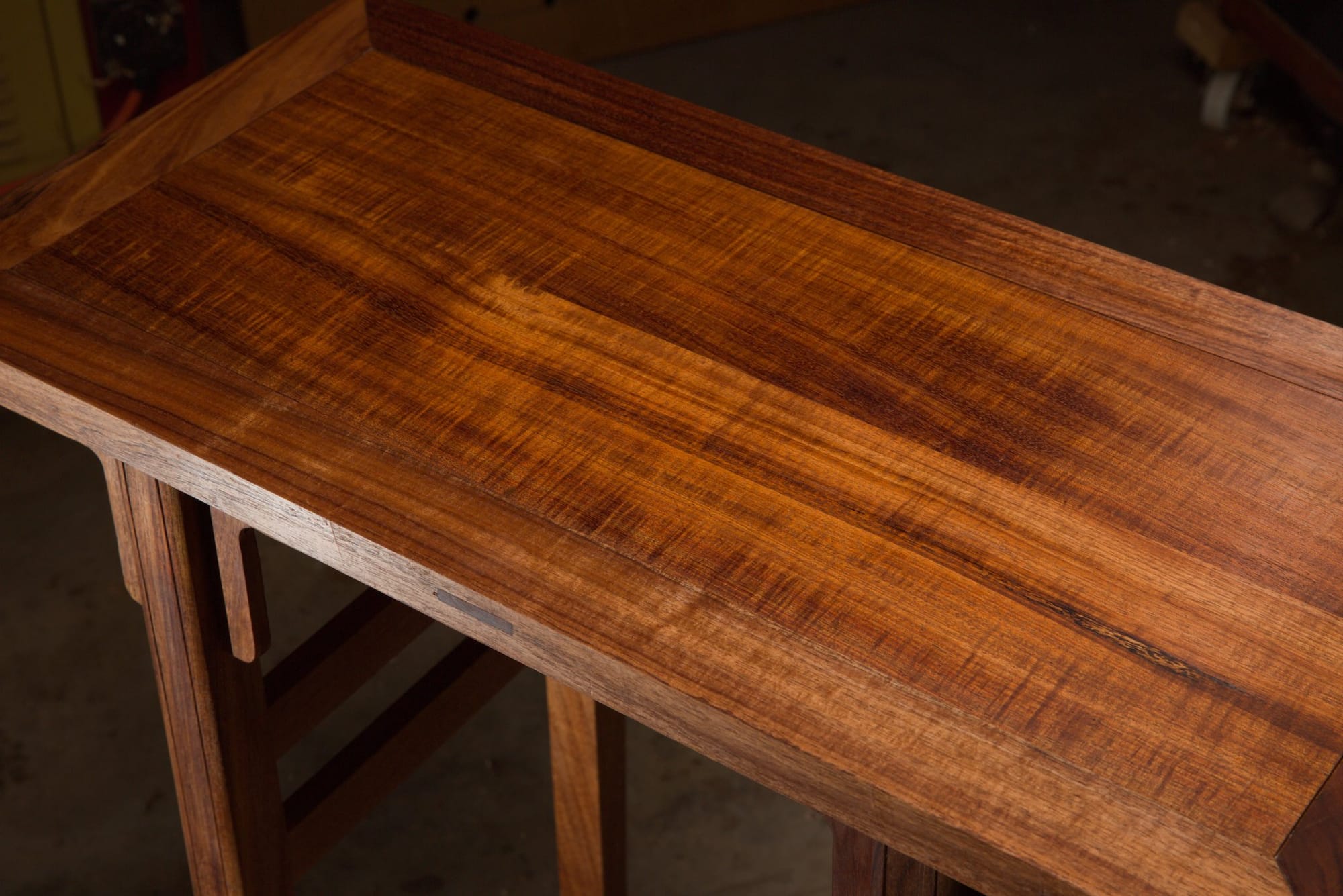
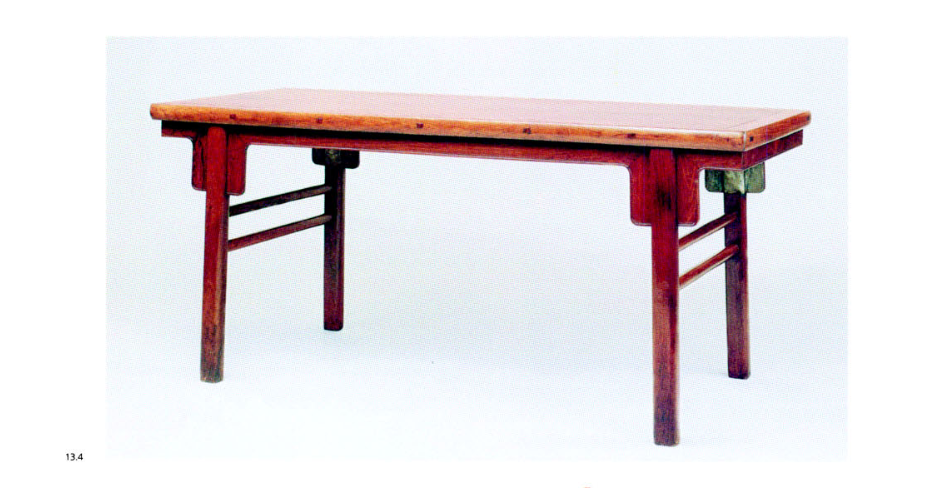
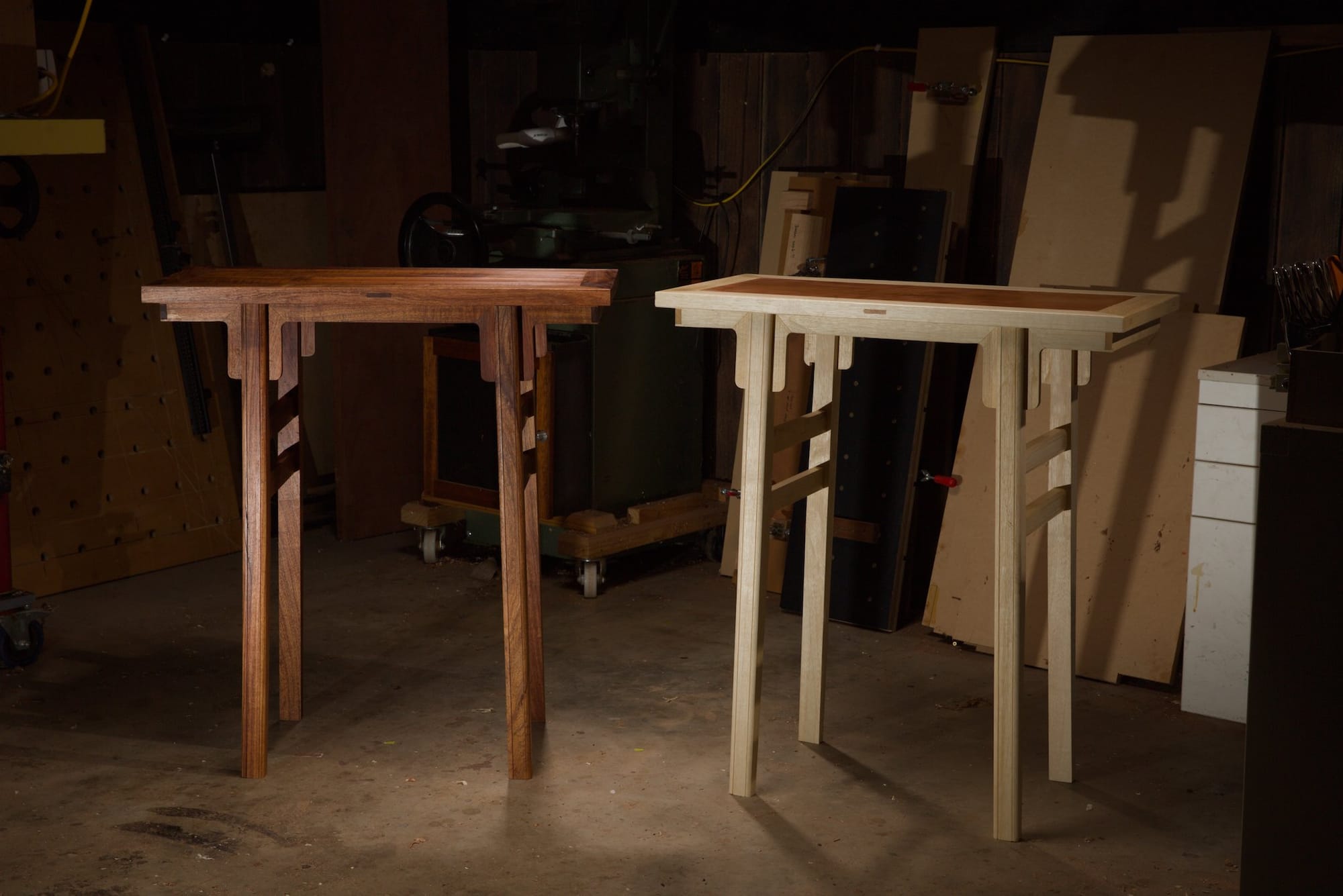
There are two tables ready to be delivered, both finished, both gleaming with the burnished wax coat. One is Silver Ash with a Tasmanian Myrtle panel. The other is all VIC Blackwood. I've been blathering about them for a couple of weeks but haven't really shown what they actually are: what the form is, where it comes from, or why I'm building this way instead of any of the other ways a person can build a table. So here it is.
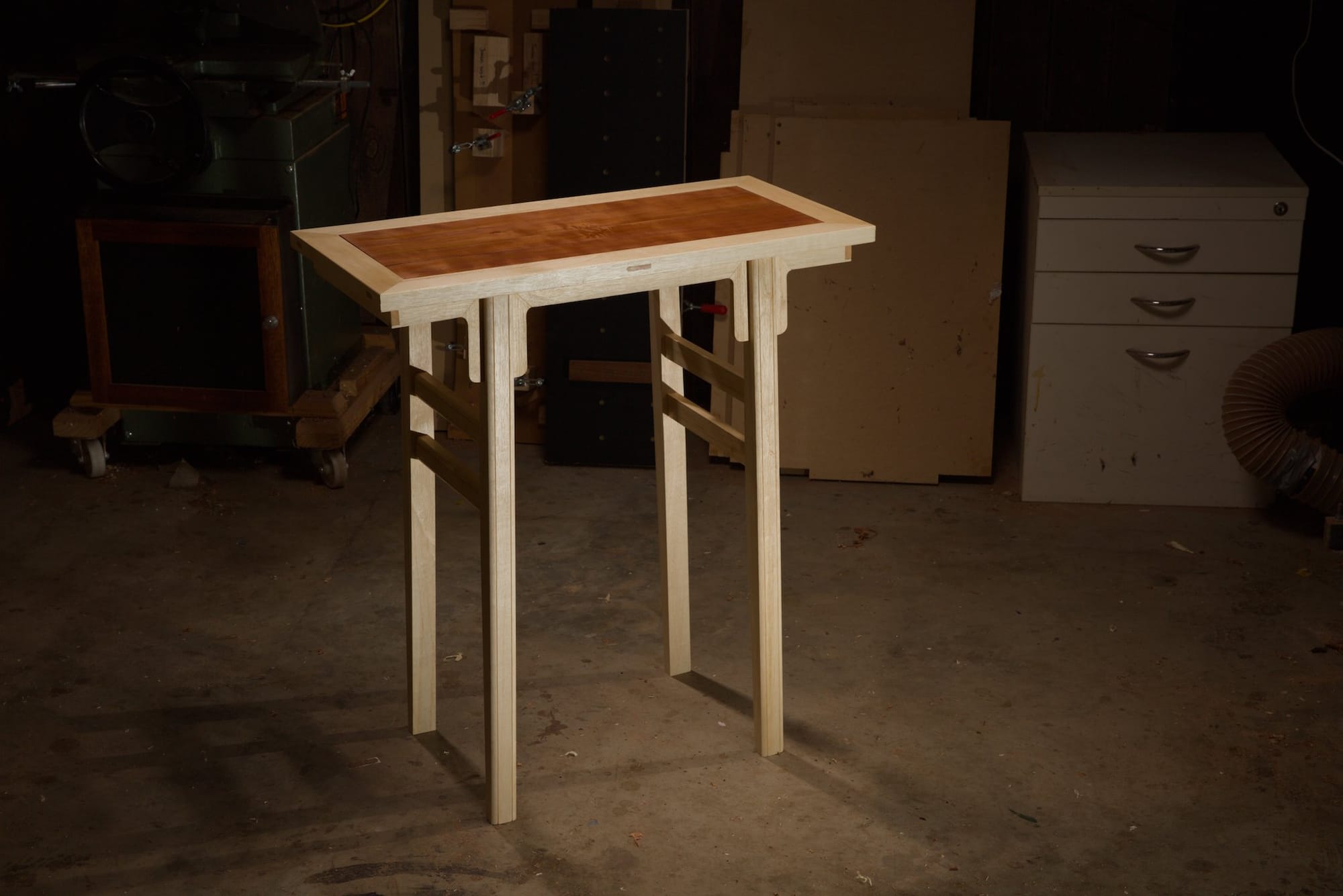
Both are àn tables, a "Classical Chinese" form going way back to at least 1000BC. The character is 案 (I hope. That one might be 'Egg Foo Yung' for all I know). If you've been reading along and wondering what I keep going on about, please read on.
In Classical Chinese furniture there are two families of table: Corner-leg tables - 桌, zhuō - have the legs at the corners; recessed-leg tables - 案, àn - have the legs set inward from the ends, so the top overhangs the base on all sides.
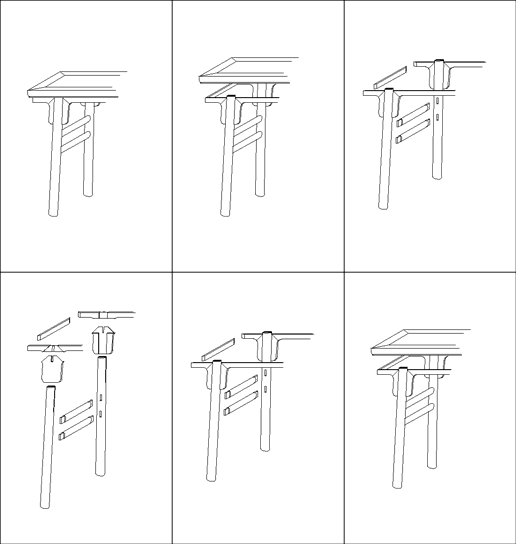
In the Western canon we have two basic ways to attach a leg to a table. You either stick a round tenon into a round mortise through the top (like this), or you tenon an apron into a mortise in the leg. The Chinese àn form does something I haven't found anywhere else: the leg clamps the apron.
The joint is called jiātóusǔn - 夹头榫 - and while that sounds terribly romantic to my ear, in English it's the Clamped-head tenon. Jiā means to clamp, to squeeze, to hold between. The leg has a slot at the top, and the apron slots into that... well, slot. A dovetail provides a mechanical force that, combined with the tenons at the top that pierce the tabletop, clamps the leg to the apron rather than the apron tenoning into the leg.
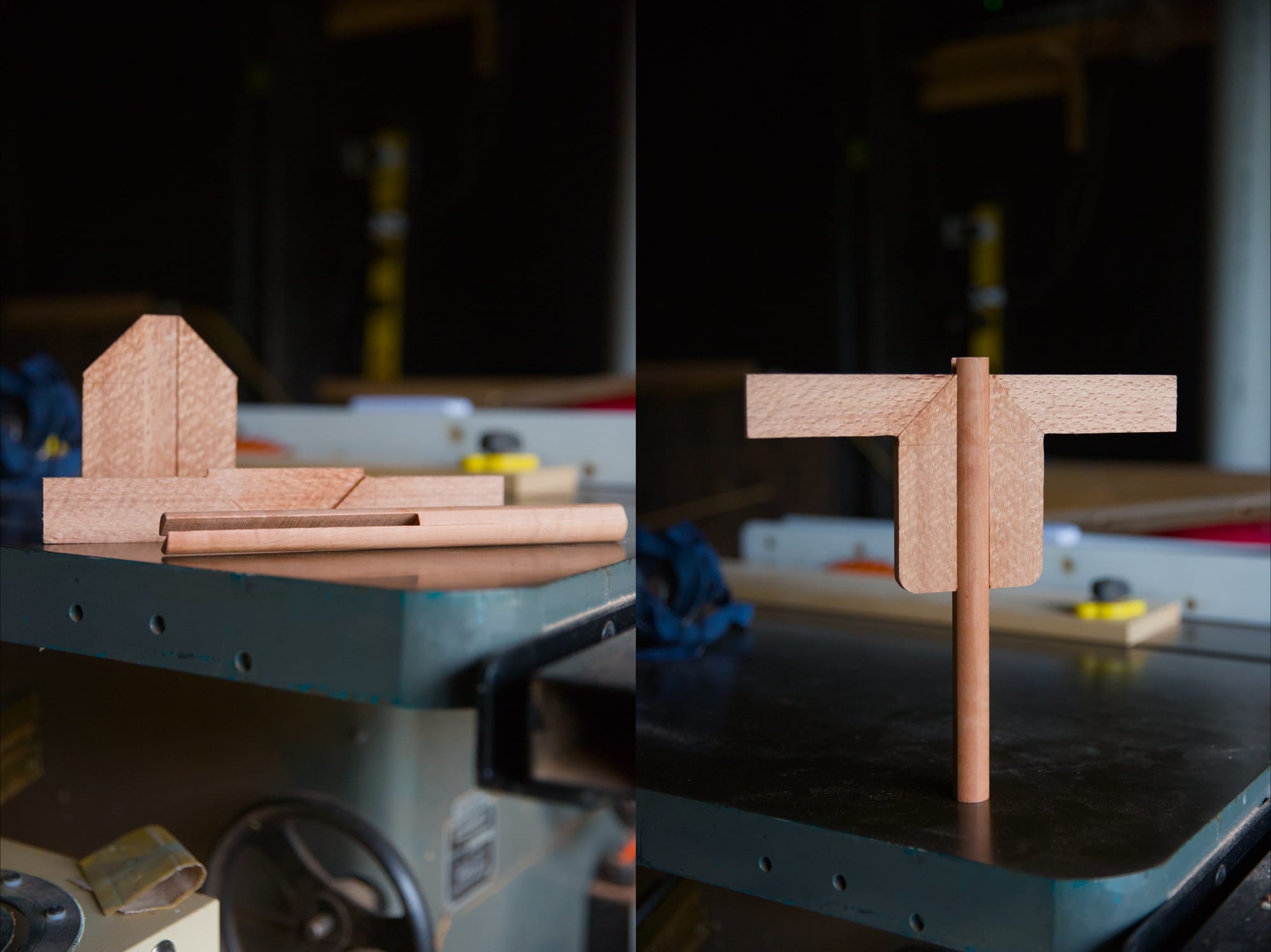
It sounds like an academic distinction, but it isn't.
When you tenon an apron into a leg the joint's strength depends on the size of the tenon, which depends on the thickness and width of the apron. A thin and narrow (aka graceful) apron means a small tenon means a limited joint. The only way to increase the strength is to increase the thickness and width of the apron.
The jiātóusǔn sort of reverses the logic. Or has its own logic. Because the leg is clamping the apron rather than receiving a tenon from it, the apron can be remarkably thin and the joint stays sound. It's not any single component taking the load, it's how they interlock that provides the strength. The spandrels provide a load-bearing face of around 120mm against the leg, where a lone tenon might offer 60mm max. The mitres at the top of each spandrel transfer load downward, so when the table is loaded the joinery snugs up and gets stronger, creating a joint that tightens under stress rather than loosening as a western tenon tends to. The bridles do the same work at the apron-to-spandrel junction, spreading force over a wide area rather than concentrating it at a single edge. These techniques allow us to use components that would be impossibly thin in a western style: the floating panel on the Blackwood table is 6.9mm thick; the aprons are 8.5mm.
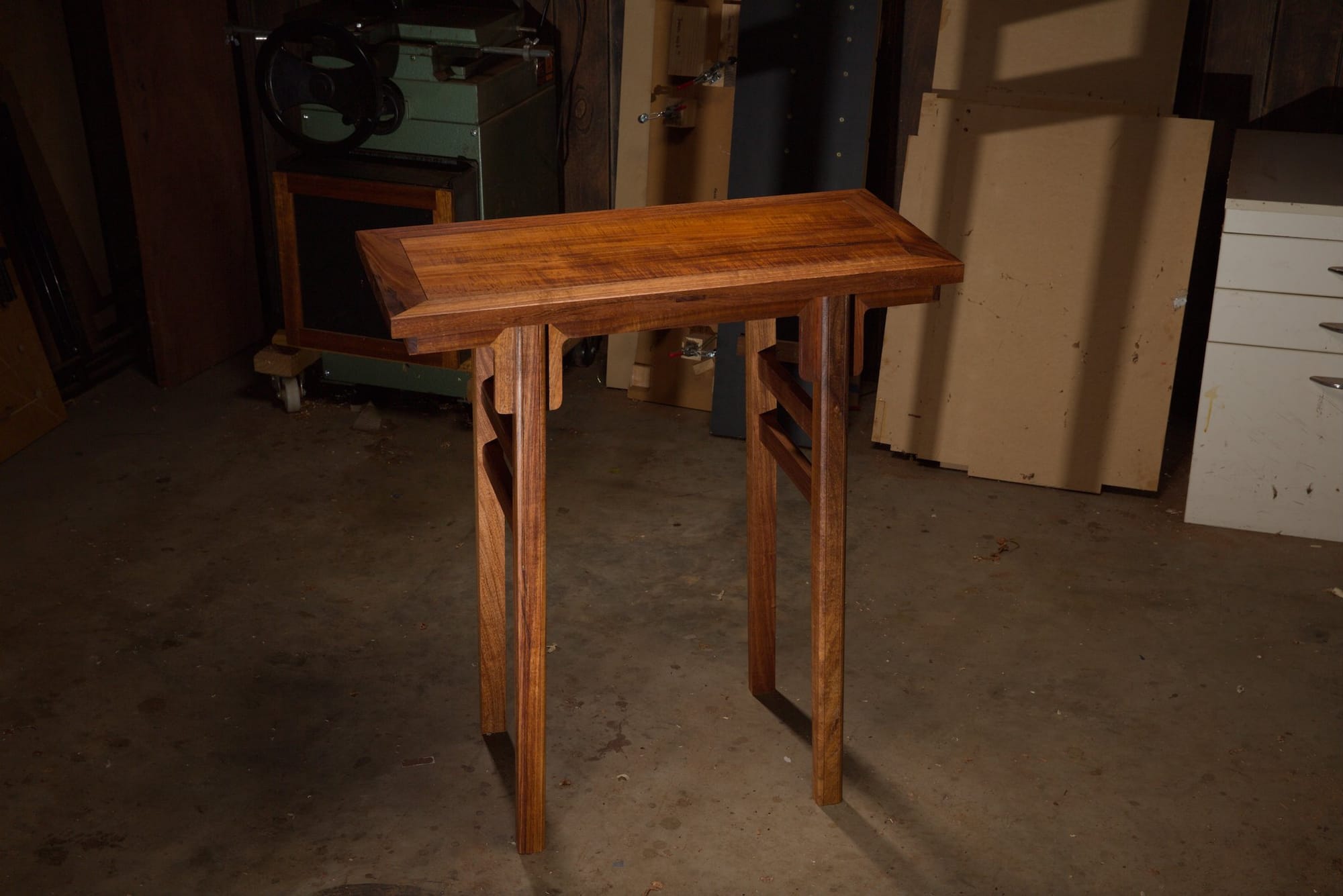
This system demands precision that the Western method I'm used to simply doesn't. There's no glue in these joints. No filler, no forgiveness. Every angle has to be exact (44.25 and 45.75 degrees exactly). If a single mitre is out, the legs don't line up. If the spandrels are off even slightly, the tenon part of the 'clamp-head tenons' don't meet their mortises, and the legs don't line up with each other. The frame corners are tenoned at 45 degrees, and if they're not exactly 45 the top isn't square and there's gaps galore. The dovetailed cross member is in there tight. All of it is tight actually, because tight joinery is the only option when there's nothing else holding it together.
The mitres do something else, too. A butt joint is an abrupt end: the eye stops. A mitre allows the grain and eye to flow along the length of the apron without interruption. Beautiful and structural at the same time is hard to pull off. The Ming masters perfected it: Wang Shixiang documented Ming dynasty examples that have survived four hundred years without being disassembled or repaired (or burned for fuel).
There's a second àn joint - chājiānsǔn, 插肩榫, the inserted shoulder tenon - where the top of the leg has a shaped shoulder that slots into a matching recess in the frame. Both systems work. Both allow the kind of component thinness that Western construction can't achieve. The two tables I've just completed are jiātóusǔn. I'll be starting a commissioned chājiānsǔn coffee table later this year.
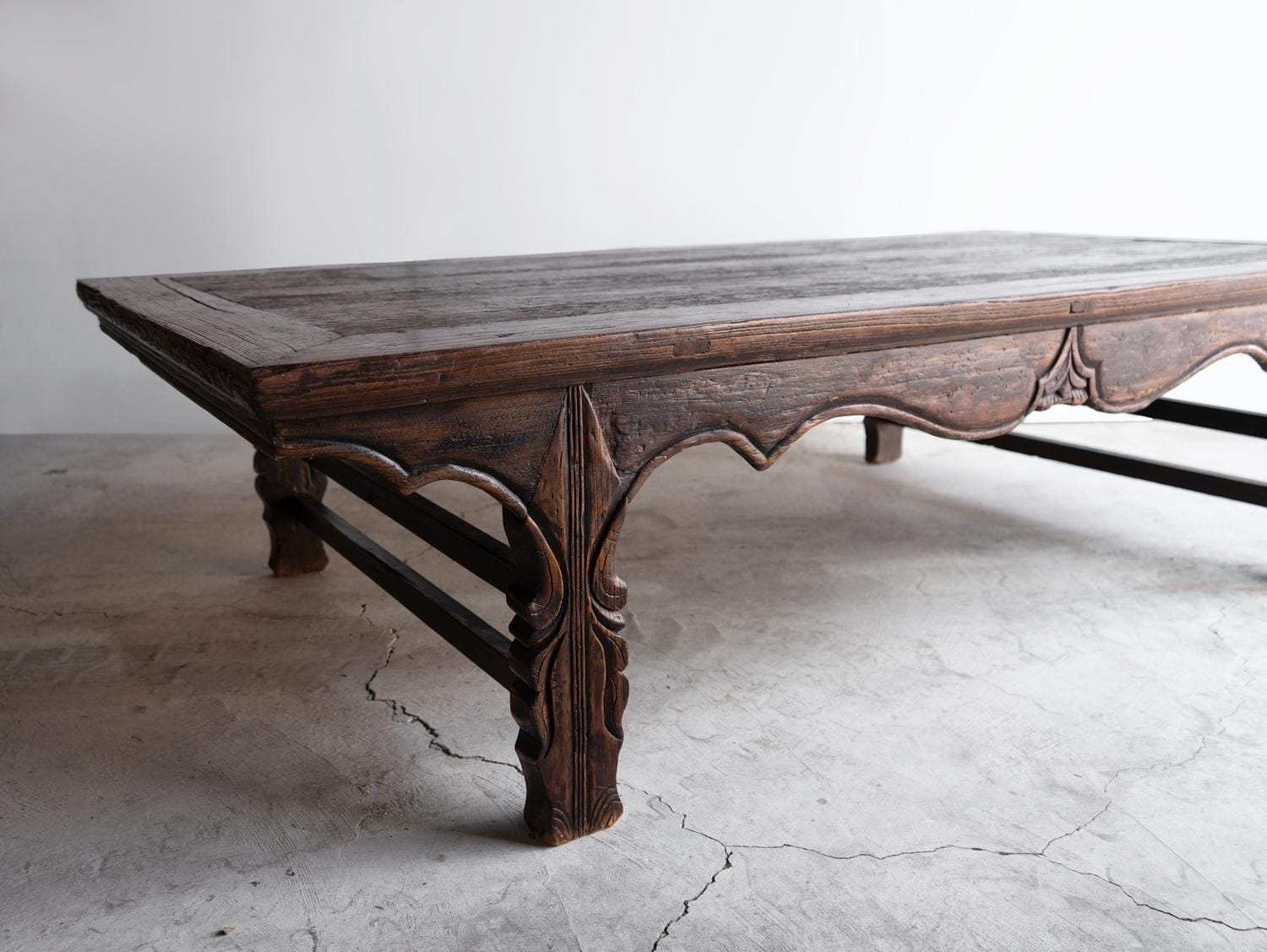
Several people have described my furniture as "surprisingly feminine," to which I quip: I'm a man, I love the female form. But it's more than a style preference. I've been unconsciously but steadily reducing the size and thickness and weight of my components over the years, from cathedral-worthy sled feet to graceful and slender ballerina legs, and the àn form feels like the logical conclusion of that trajectory. The jiātóusǔn lets you build a table that is genuinely strong with components so thin they look like they shouldn't work. But they do work. They've been holding tables together since long before the Ming dynasty began.
I made no major mistakes on this project. That's not a boast, it's a surprise. The form, its complexity and its newness required me to slow down and think. Instead of designing on the fly as I usually do, I was forced to plan each step carefully. Every time I was tempted to wing a cut, the tolerances reminded me to stop and make a jig instead. Each jig added hours or days to the build. But each jig meant the cut it guided was right the first time, and making no mistakes and not having to remake any pieces meant the build wasn't any slower than normal. Going slow to go fast. I didn't know I was capable of this level of precision until the work demanded it and I discovered that I was.
These two go to The Hive gallery for June's timber exhibition. Heck, it would be silly to not mention that they are also for sale. EDIT: The Blackwood table is now sold, but the Silver Ash still available, and both will still be residing at the Hive Gallery for the month of June.
Join the conversation